Every industry in Pennsylvania
- Manufacturing & Industrial · $100K–$1.5M
- Law Firms · $50K–$1.2M
- Medical Practices & Health Systems · $80K–$820K
- Accounting & Tax Firms · $25K–$865K
- Construction Companies · $115K–$1M
- Software Companies · $50K–$500K
- Consulting & Advisory Firms · $150K–$300K
- Investment Firms · $50K–$800K
- Digital Health Companies · $100K–$900K
- Insurance Agencies · $100K–$400K
- Game Studios · $100K–$1M
- Publishers & Education Companies · $35K–$370K
- Call Centers & BPO · $20K–$250K
- Consumer Brands & Photo Studios · $30K–$800K
- Cybersecurity Companies · $20K–$750K
- Design & Web Agencies · $20K–$890K
- Payments & Fintech Companies · $80K–$900K
- Biotech & Life Sciences · $50K–$875K
- Hardware Engineering Companies · $45K–$1.3M
- Hedge Funds & Quant Firms · $25K–$1.1M
Top counties in Pennsylvania
- Manufacturing & Industrial: Lancaster (1,012)
- Law Firms: Allegheny (4,094)
- Medical Practices & Health Systems: Allegheny (4,791)
- Accounting & Tax Firms: Allegheny (4,094)
- Construction Companies: Allegheny (2,719)
- Software Companies: Allegheny (707)
- Consulting & Advisory Firms: Allegheny (4,094)
- Investment Firms: Allegheny (2,179)
- Digital Health Companies: Allegheny (4,791)
- Insurance Agencies: Allegheny (2,179)
Top county by establishments for each trade. Source: Census County Business Patterns, 2022.
Pennsylvania at a glance
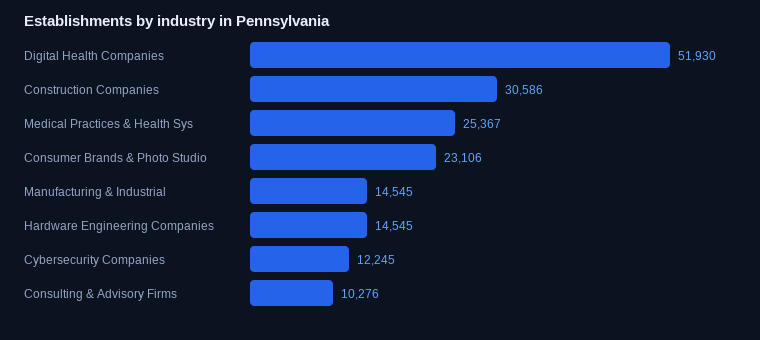
The local base in Pennsylvania
- Manufacturing & Industrial: 14,545 establishments, 566,154 employees
- Law Firms: 6,567 establishments, 48,084 employees
- Medical Practices & Health Systems: 25,367 establishments, 364,720 employees
- Accounting & Tax Firms: 5,477 establishments, 39,123 employees
- Construction Companies: 30,586 establishments, 260,646 employees
- Software Companies: 9,065 establishments, 93,229 employees
- Consulting & Advisory Firms: 10,276 establishments, 58,979 employees
- Investment Firms: 5,136 establishments, 48,732 employees
- Digital Health Companies: 51,930 establishments, 1,069,029 employees
- Insurance Agencies: 7,704 establishments, 128,965 employees
- Game Studios: 9,065 establishments, 93,229 employees
- Publishers & Education Companies: 9,065 establishments, 93,229 employees
- Call Centers & BPO: 1,307 establishments, 21,049 employees
- Consumer Brands & Photo Studios: 23,106 establishments, 216,992 employees
- Cybersecurity Companies: 12,245 establishments, 76,718 employees
- Design & Web Agencies: 1,263 establishments, 4,078 employees
- Payments & Fintech Companies: 7,468 establishments, 92,835 employees
- Biotech & Life Sciences: 2,425 establishments, 47,222 employees
- Hardware Engineering Companies: 14,545 establishments, 566,154 employees
- Hedge Funds & Quant Firms: 5,136 establishments, 48,732 employees
Source: BLS QCEW, 2023 annual averages.
What stays the same
No data moves until you sign. The buyer pays you. The published band is a ceiling, not an offer.
Pennsylvania companies are eligible for US buyer programs when the records and rights fit.
The Pennsylvania business base runs on manufacturing, healthcare, education and logistics, and those are the teams in Pennsylvania most likely to hold records a buyer wants.
Ownership and permission come first
Licensing can give a buyer permission to use specified data while your company keeps ownership. The agreement should make that distinction explicit. Before discussing access, identify what your company owns and what it holds under someone else’s terms. Possessing records does not, by itself, establish permission to license everything they contain.
Contracts with employees, suppliers and other parties may affect what you can offer. Separate company material from information that needs further review. If ownership or permission remains unclear, keep that material outside the proposed scope until the issue is resolved. A buyer should receive a defined license with clear limits.
What a buyer receives
A buyer receives access to the material described in the agreement, with permission for the uses that agreement allows. Describe the proposed delivery clearly: which records are included, what fields they contain, how they are organized and whether updates are included. Avoid treating an entire company database as the default package.
Useful descriptions explain where the data came from, what it covers and where gaps exist. For Pennsylvania businesses in manufacturing, healthcare or rail logistics, those details help distinguish very different collections. The proposed terms should also address access duration, sharing and retention, so both sides understand what delivery would actually involve.
The published band is a ceiling
The published band is a ceiling, not a forecast. It does not predict what your company will receive or establish that a buyer will make an offer. Keep that distinction in view when considering a possible license. A broad published range cannot settle the value of a specific collection of records.
Pennsylvania’s manufacturing, healthcare, education and logistics businesses provide context for the page, but that business base does not establish demand for your particular data. Establishment and employment counts describe sectors. They do not tell you whether your records fit a buyer’s needs, whether permission is clear or what terms would be agreed.
Check a range with the calculator
Start by checking a range with the calculator. No files are uploaded for this step. Use it as an initial reference while you consider what your company might be able to license. Read the result alongside the ceiling explanation above, without treating it as an expected payment or a confirmed offer.
Afterward, outline the collection you have in mind without attaching the underlying records. Note its subject, source, coverage and any known ownership questions. That description can help you assess what needs review before a possible licensing discussion. The immediate next step remains simple: check the calculator range without uploading files.
Where these numbers come from
Establishment and pay counts come from BLS QCEW 2023 annual averages and Census County Business Patterns 2022. The published band is what buyers list.
The median confirmed sale in this market sits well below the top of that band. Treat the range as a ceiling, not a forecast.
Check your range
Six questions. No files. You get a range and the buyers whose rules fit.
Check my range · Book a fit call
Questions
Which industries qualify in Pennsylvania?
Any industry on the list for Pennsylvania can qualify when the company has the records, years and rights a buyer wants.
Do I have to be a tech company?
No. Manufacturers, law firms, medical practices and construction companies in Pennsylvania qualify when the records and rights fit.
Does it cost anything?
Most buyers charge the company nothing. A broker is paid only if a deal closes.
Which Pennsylvania metros does this page cover?
The named metros are Philadelphia, Pittsburgh and Harrisburg.
Which environmental regulator is listed for Pennsylvania?
The listed regulator is PA DEP.
How many construction establishments are listed?
Pennsylvania has 30,586 construction establishments, with 260,646 employees.