Every industry in Indiana
- Manufacturing & Industrial · $100K–$1.5M
- Law Firms · $50K–$1.2M
- Medical Practices & Health Systems · $80K–$820K
- Accounting & Tax Firms · $25K–$865K
- Construction Companies · $115K–$1M
- Software Companies · $50K–$500K
- Consulting & Advisory Firms · $150K–$300K
- Investment Firms · $50K–$800K
- Digital Health Companies · $100K–$900K
- Insurance Agencies · $100K–$400K
- Game Studios · $100K–$1M
- Publishers & Education Companies · $35K–$370K
- Call Centers & BPO · $20K–$250K
- Consumer Brands & Photo Studios · $30K–$800K
- Cybersecurity Companies · $20K–$750K
- Design & Web Agencies · $20K–$890K
- Payments & Fintech Companies · $80K–$900K
- Biotech & Life Sciences · $50K–$875K
- Hardware Engineering Companies · $45K–$1.3M
- Hedge Funds & Quant Firms · $25K–$1.1M
Top counties in Indiana
- Manufacturing & Industrial: Elkhart (835)
- Law Firms: Marion (2,660)
- Medical Practices & Health Systems: Marion (2,986)
- Accounting & Tax Firms: Marion (2,660)
- Construction Companies: Marion (1,873)
- Software Companies: Marion (467)
- Consulting & Advisory Firms: Marion (2,660)
- Investment Firms: Marion (1,298)
- Digital Health Companies: Marion (2,986)
- Insurance Agencies: Marion (1,298)
Top county by establishments for each trade. Source: Census County Business Patterns, 2022.
Indiana at a glance
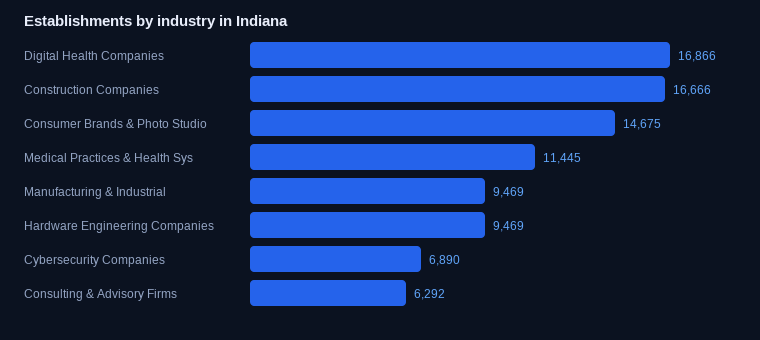
The local base in Indiana
- Manufacturing & Industrial: 9,469 establishments, 533,046 employees
- Law Firms: 2,885 establishments, 14,369 employees
- Medical Practices & Health Systems: 11,445 establishments, 167,819 employees
- Accounting & Tax Firms: 2,702 establishments, 18,387 employees
- Construction Companies: 16,666 establishments, 162,433 employees
- Software Companies: 3,228 establishments, 26,676 employees
- Consulting & Advisory Firms: 6,292 establishments, 29,335 employees
- Investment Firms: 2,422 establishments, 11,269 employees
- Digital Health Companies: 16,866 establishments, 434,714 employees
- Insurance Agencies: 5,015 establishments, 49,927 employees
- Game Studios: 3,228 establishments, 26,676 employees
- Publishers & Education Companies: 3,228 establishments, 26,676 employees
- Call Centers & BPO: 920 establishments, 10,009 employees
- Consumer Brands & Photo Studios: 14,675 establishments, 133,423 employees
- Cybersecurity Companies: 6,890 establishments, 34,770 employees
- Design & Web Agencies: 555 establishments, 1,694 employees
- Payments & Fintech Companies: 3,888 establishments, 41,881 employees
- Biotech & Life Sciences: 857 establishments, 5,690 employees
- Hardware Engineering Companies: 9,469 establishments, 533,046 employees
- Hedge Funds & Quant Firms: 2,422 establishments, 11,269 employees
Source: BLS QCEW, 2023 annual averages.
What stays the same
No data moves until you sign. The buyer pays you. The published band is a ceiling, not an offer.
Indiana companies are eligible for US buyer programs when the records and rights fit.
The Indiana business base runs on manufacturing, logistics, healthcare and agriculture, and those are the teams in Indiana most likely to hold records a buyer wants.
Does your company own the data it wants to license?
Having company data does not automatically mean your company can license every part of it. Check where the records came from and what agreements cover them. Separate material your company created from material supplied by another party. If ownership or permission is unclear, identify that gap before describing the data as available to a buyer.
Indiana’s business base includes manufacturing, logistics, healthcare and agriculture. Start the ownership review with the records you intend to offer, rather than assuming everything in a company system belongs to the company. Describe what your company created, what came from elsewhere, and what needs further review. Keep unresolved material outside the proposed offer until those questions are answered.
What does a buyer receive?
A buyer receives the data described in the agreement and permission to use it within agreed limits. The offer should explain which records are included, how they are delivered, and what accompanying documentation explains them. State whether the proposed license covers a fixed dataset or includes updates. Leave no uncertainty about what delivery means.
Delivery details should distinguish the contents from the permitted uses. Describe the format, field definitions, coverage and known gaps so a buyer can assess the material. Separately, specify whether the proposed terms permit model training, evaluation or other uses. Do not imply that receiving a dataset gives a buyer ownership of the company’s underlying systems or unrestricted rights.
The published band is a ceiling, not a forecast
Treat the published band as a ceiling, not a forecast. It does not say what your company will earn or promise that a buyer will make an offer. Use it to frame an initial discussion about a possible license. Do not present it internally as expected revenue or an agreed price.
Sector counts provide context about Indiana’s business base, but they do not establish demand for your particular records. Manufacturing, truck logistics and agriculture are listed clusters. That context cannot tell you whether a buyer wants your dataset, accepts its restrictions or agrees with its proposed price. Those questions remain open until the actual offer is assessed.
Next step: check a range with the calculator
Use the calculator to check a range. No files need to be uploaded for this step. Keep the result alongside a brief description of the data you are considering licensing. Include its source, its coverage and any unresolved ownership questions so the range stays connected to a clearly described potential offer.
Afterward, review the result against what your company could actually provide. A calculator range does not confirm ownership, establish permission or represent an offer from a buyer. The next decision is whether the proposed dataset is defined clearly enough to discuss. Keep the published ceiling separate from any expectation about the eventual outcome.
Where these numbers come from
Establishment and pay counts come from BLS QCEW 2023 annual averages and Census County Business Patterns 2022. The published band is what buyers list.
The median confirmed sale in this market sits well below the top of that band. Treat the range as a ceiling, not a forecast.
Check your range
Six questions. No files. You get a range and the buyers whose rules fit.
Check my range · Book a fit call
Questions
Which industries qualify in Indiana?
Any industry on the list for Indiana can qualify when the company has the records, years and rights a buyer wants.
Do I have to be a tech company?
No. Manufacturers, law firms, medical practices and construction companies in Indiana qualify when the records and rights fit.
Does it cost anything?
Most buyers charge the company nothing. A broker is paid only if a deal closes.
Which Indiana metros are listed?
Indianapolis, Fort Wayne and South Bend are the listed metros.
How large is Indiana’s listed construction sector?
Construction Companies account for 16,666 establishments and 162,433 employees.
Which regulator is listed for Indiana?
IDEM is the listed regulator.