Every industry in California
- Manufacturing & Industrial · $100K–$1.5M
- Law Firms · $50K–$1.2M
- Medical Practices & Health Systems · $80K–$820K
- Accounting & Tax Firms · $25K–$865K
- Construction Companies · $115K–$1M
- Software Companies · $50K–$500K
- Consulting & Advisory Firms · $150K–$300K
- Investment Firms · $50K–$800K
- Digital Health Companies · $100K–$900K
- Insurance Agencies · $100K–$400K
- Game Studios · $100K–$1M
- Publishers & Education Companies · $35K–$370K
- Call Centers & BPO · $20K–$250K
- Consumer Brands & Photo Studios · $30K–$800K
- Cybersecurity Companies · $20K–$750K
- Design & Web Agencies · $20K–$890K
- Payments & Fintech Companies · $80K–$900K
- Biotech & Life Sciences · $50K–$875K
- Hardware Engineering Companies · $45K–$1.3M
- Hedge Funds & Quant Firms · $25K–$1.1M
Top counties in California
- Manufacturing & Industrial: Los Angeles (10,448)
- Law Firms: Los Angeles (42,722)
- Medical Practices & Health Systems: Los Angeles (37,635)
- Accounting & Tax Firms: Los Angeles (42,722)
- Construction Companies: Los Angeles (17,404)
- Software Companies: Los Angeles (13,054)
- Consulting & Advisory Firms: Los Angeles (42,722)
- Investment Firms: Los Angeles (13,124)
- Digital Health Companies: Los Angeles (37,635)
- Insurance Agencies: Los Angeles (13,124)
Top county by establishments for each trade. Source: Census County Business Patterns, 2022.
California at a glance
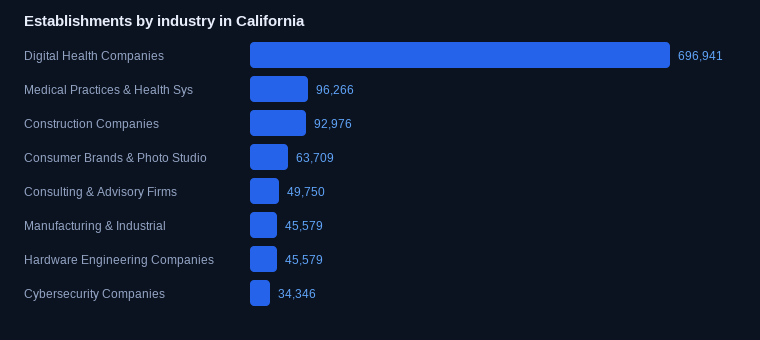
The local base in California
- Manufacturing & Industrial: 45,579 establishments, 1,329,590 employees
- Law Firms: 24,800 establishments, 147,848 employees
- Medical Practices & Health Systems: 96,266 establishments, 980,010 employees
- Accounting & Tax Firms: 20,169 establishments, 145,291 employees
- Construction Companies: 92,976 establishments, 911,333 employees
- Software Companies: 31,707 establishments, 558,978 employees
- Consulting & Advisory Firms: 49,750 establishments, 227,490 employees
- Investment Firms: 16,374 establishments, 102,054 employees
- Digital Health Companies: 696,941 establishments, 2,621,434 employees
- Insurance Agencies: 18,423 establishments, 192,635 employees
- Game Studios: 31,707 establishments, 558,978 employees
- Publishers & Education Companies: 31,707 establishments, 558,978 employees
- Call Centers & BPO: 5,097 establishments, 45,507 employees
- Consumer Brands & Photo Studios: 63,709 establishments, 666,335 employees
- Cybersecurity Companies: 34,346 establishments, 338,945 employees
- Design & Web Agencies: 7,816 establishments, 26,342 employees
- Payments & Fintech Companies: 17,697 establishments, 206,424 employees
- Biotech & Life Sciences: 7,032 establishments, 191,935 employees
- Hardware Engineering Companies: 45,579 establishments, 1,329,590 employees
- Hedge Funds & Quant Firms: 16,374 establishments, 102,054 employees
Source: BLS QCEW, 2023 annual averages.
What stays the same
No data moves until you sign. The buyer pays you. The published band is a ceiling, not an offer.
California companies are eligible for US buyer programs when the records and rights fit.
The California business base runs on technology, agriculture, entertainment and logistics, and those are the teams in California most likely to hold records a buyer wants.
Ownership and permission come first
Selling access to company data does not have to mean transferring ownership. A license can give a buyer defined permission to use data while your company retains ownership. The agreement should state what uses are allowed, whether sharing is permitted, and what happens when access ends. These terms need agreement before any delivery.
Before offering data, check whether your company has the rights needed for the proposed use. Holding a file does not establish permission to license everything inside it. Review relevant contracts and any restrictions attached to its contents. If ownership or permission is unclear, resolve that question before describing the material as available to a buyer.
Define what a buyer receives
A buyer should receive the material and usage rights described in the agreement. Specify the included records, their format, the period they cover, and any exclusions. Make clear whether the proposed delivery is a fixed collection or includes updates. Avoid describing access more broadly than your company can provide under the agreed terms.
Delivery details should also explain how a buyer can interpret the material. Depending on the data, that could include field definitions, collection methods, and known gaps. Agree on these items during review. A description of your business category alone does not tell a buyer what the files contain or which uses the license permits.
The published band is a ceiling, not a forecast
The published band is a ceiling, not a forecast. It does not predict what your company will receive or establish that a buyer will make an offer. Treat it as an upper boundary for the displayed range. Any proposed price would still need to relate to the specific data and the rights being offered.
California’s business base includes technology, agriculture, entertainment and logistics. Its clusters include aerospace, agriculture and port logistics. That context describes the state’s business activity; it does not establish demand for your particular records. Establishment and employee counts also describe scale, rather than the contents, ownership, usability or price of a dataset your company might offer.
Check a range with the calculator
Use the calculator to check a range without uploading files. Start with a description of the company data you might offer, keeping the ownership questions above in mind. Read the result alongside the ceiling explanation. This step gives you a range to consider before deciding whether to explore a possible license further.
Review the result against what you can actually describe and provide. Note any unresolved questions about permission, contents, delivery or allowed uses before taking the discussion further. Keep the distinction clear between a calculator result and an agreed price. You do not need to upload company files to check a range with the calculator.
Where these numbers come from
Establishment and pay counts come from BLS QCEW 2023 annual averages and Census County Business Patterns 2022. The published band is what buyers list.
The median confirmed sale in this market sits well below the top of that band. Treat the range as a ceiling, not a forecast.
Check your range
Six questions. No files. You get a range and the buyers whose rules fit.
Check my range · Book a fit call
Questions
Which industries qualify in California?
Any industry on the list for California can qualify when the company has the records, years and rights a buyer wants.
Do I have to be a tech company?
No. Manufacturers, law firms, medical practices and construction companies in California qualify when the records and rights fit.
Does it cost anything?
Most buyers charge the company nothing. A broker is paid only if a deal closes.
Which California metros are listed?
Los Angeles, the Bay Area and San Diego.
How large is California’s population?
California has about 39.0 million people.
How many construction establishments and employees are listed?
Construction Companies account for 92,976 establishments and 911,333 employees.